Travel diary · 2023
Discovering Poland’s Stud Farms
A journey through Poland’s private and state stud farms
26 September 2023 · Sieraków
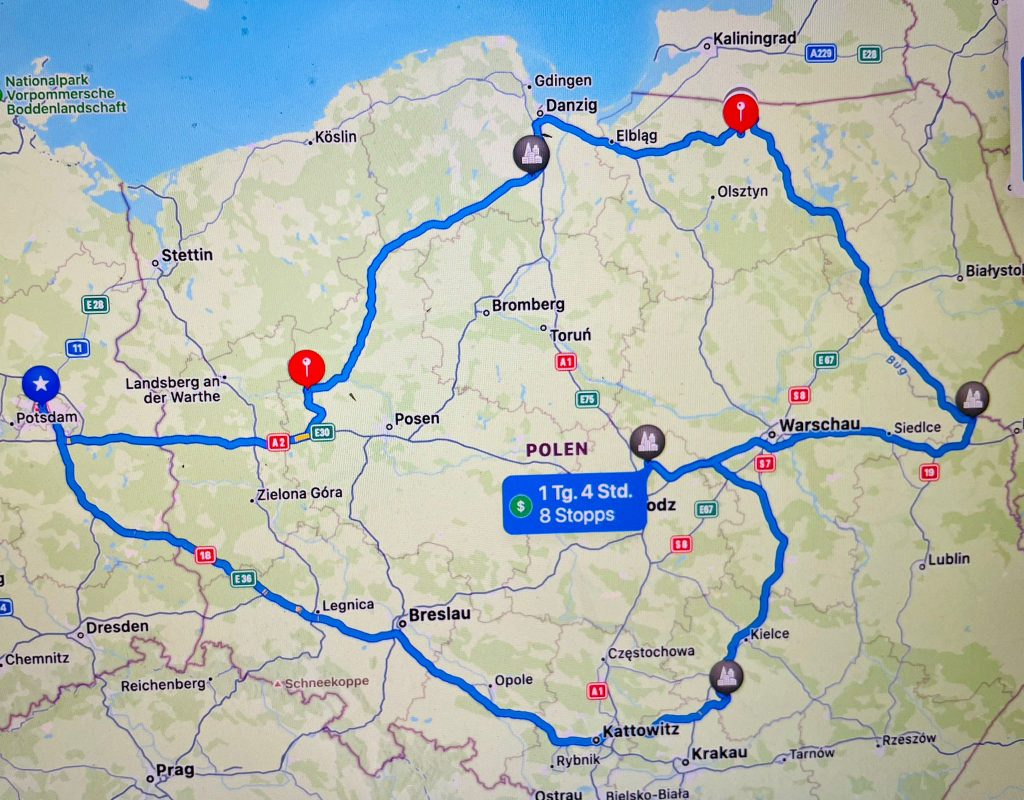
The first day of our tour took us to Sieraków (Zilke) in former Pomerania, only about 170 km from Berlin.
Founded by the King of Prussia in 1827, the stud retains its complete historic buildings and is still operating as a breeding centre and stallion station. Its layout clearly shows the structure of studs once managed by the Prussian stud administration.
Sieraków is Poland’s oldest stallion station and remains one of western Poland’s most important breeding centres.
Sieraków is also known far beyond Poland for equestrian sport and, particularly, for breeding the now rare Konik horses.
Some of the stables house a unique carriage exhibition, with their historic interiors beautifully preserved. Other stud buildings contain museums and lovingly curated displays of the stud’s history.
27 September 2023 · Malbork – Róznowo – Liski
First stop: a visit to Malbork Castle
Malbork Castle was built in the 13th century by the Teutonic Knights. With 21 hectares of buildings, it is regarded as the world’s largest castle. It is also Europe’s largest brick building. Its characteristic Brick Gothic style influenced important brick buildings throughout Europe. The castle is, of course, a UNESCO World Heritage Site. Modern audio guides with fascinating and informative commentary made the visit enjoyable and educational.
Second stop: Róznowo Trakehner Stud
Next on the programme was Róznowo Trakehner Stud in former East Prussia, operating since 1993. The owners proudly presented several age groups of mares. All the horses were in excellent condition and a pleasure to see. We were welcomed with a delicious snack of typical Polish specialities, and finished by raising a glass of Polish vodka. Everyone on the trip was impressed by the warmth and pride with which the owners showed us their stud and breeding programme.
Third stop: Liski Stud
Liski was founded as a remount depot in 1876. Remount depots were responsible for training horses for the military. The site still retains the layout of a remount depot of that period and remains in use today: four stables with large paddocks in front, linked by broad avenues that cross among the trees, and the manor house at the end of the main avenue.
Around 1950, all Trakehner horses then remaining in Poland were brought together at Liski. Approximately 30 Trakehner mares that had reached Germany with the evacuation trek were also returned to Liski to help establish the Trakehner stud.
After periods of decline, Liski was saved and is now slowly flourishing again. Stallions, mares and mares with this year’s foals were proudly presented to us.
28 September 2023 · Galiny – Eichmedien – Masurian Lakes – Steinort
I woke up at beautiful Galiny Stud in former East Prussia. The palace was built in 1589 for Baron Botho zu Eulenburg and remains a historic estate with a beautiful 19th-century park. Its last owner, Count Botho Wend zu Eulenburg, died during deportation to Siberia in 1945.
The palace, abandoned for years, and its neglected, rubbish-strewn park were bought together with the outlying farm by the current owners in 1996 and restored to their wonderful present condition.
First stop: Eichmedien
Eichmedien was established as an estate village around 1400. A new manor house was built in the 17th century. The castle and surrounding estates were occupied and managed by the von Redecker family until 26 January 1945.
Since 1998 the castle and park have been carefully renovated and restored. The park includes a wonderful vegetable and herb garden, laid out in keeping with the park, with each bed framed by beautiful box hedges.
Second stop: a boat trip on the Masurian Lakes
The Masurian Lake District is Poland’s largest, with more than 2,700 lakes of at least one hectare each. Views stretch for miles across the rolling landscape, dotted with storks’ nests. Seeing this beautiful countryside helps one understand the longing expressed in the East Prussian song for the former homeland, remembered so fondly and never forgotten by its former inhabitants.
In glorious weather, I enjoyed a two-hour boat trip across some of these beautiful lakes before we arrived at our next stop, Steinort.
Third stop: Steinort
Steinort was the ancestral seat of the von Lehnhoff family for more than 500 years. Approaching from the lake, we already had a beautiful view of the castle and estate.
I had not realised that Steinort is only about 15 km from the Wolf’s Lair, the former “Führer headquarters”. Nor had I known that, because of this proximity, Hitler’s foreign minister Ribbentrop had lodged with the von Lehnhoff family since the early 1940s, occupying an entire wing with his staff.
Knowing this, I now better understand the so-called double life of Count von Lehndorff, also the subject of a book by Antje Vollmer. While Ribbentrop and his staff occupied one wing for years, von Lehnhoff helped organise the July 1944 attempt on Hitler’s life in the other. He belonged to Count von Stauffenberg’s inner circle.
A few days after the failed assassination attempt, the count was arrested and executed shortly afterwards. His wife was arrested and their three children were sent to camps.
Today a German-Polish foundation is restoring and conserving the castle in accordance with heritage requirements, preserving this historically significant place for future generations.
Today was a wonderful day, but also a deeply thought-provoking one. Hearing on the spot about war, flight, expulsion and the destruction of centuries-old families and their history moved me much more than I had expected.
29 September 2023 · Schlobitten – Jadamovo Stud
First stop: Schlobitten
Many know the books by the von Dohna family and others about their beloved homeland and life in former East Prussia. Among horse breeders, Countess Alexandra Dohna, a grande dame of the East Prussian aristocracy, was known well beyond Trakehner circles as a passionate horse lover and expert. She was also a leading photographer of the international jet set in Munich and Nice. Those who knew her always described her as modest, down-to-earth and deeply socially committed.
Over the years I have heard and read much about this impressive woman and her eventful life. Visiting her former home, Schlobitten Castle, was therefore already one of my personal highlights before the journey began. Erhard Schulte, a close friend of hers for many decades, shared affectionate anecdotes as well as stories full of respect and sadness about what she experienced, what she lost and how magnificently she dealt with it.
This morning, the time finally came. We visited the remains of the Dohna family seat. Built in 1624, this Baroque palace was also called the Versailles of East Prussia. Until 1945 it was one of the country’s most beautiful Baroque palaces. In January 1945 the Russian army first looted it, then set it on fire. The ruin I saw today has stood since 1945 as a kind of memorial or witness to that time.
The stories told in front of the ruin brought its former life and splendour, and the countess’s childhood there, back to life. This visit will stay in my thoughts for a long time. It was a special moment, thanks also to Erhard’s wonderful storytelling.
Second stop: Jadamovo Stud
Established in 1846 as an outlying farm of the Counts Fink von Finkenstein at Wittmannsdorf, the estate was bought by its present owners in 1995. A handsome manor house is surrounded by a park with magnificent trees. The owners care for the park with great devotion and do their utmost to preserve the house.
Their son, who grew up in the USA and now works in Hong Kong, has developed an ambitious Trakehner breeding programme here in recent years, with an excellent stud manager looking after it. After a warm welcome from the whole family, we were taken through the park and proudly shown a selection of their important mares and foals. We enjoyed the presentation in glorious sunshine amid a magnificent landscape.
Last night we arrived in Janów Podlaski. The hotel looked spectacular, with a full moon hanging directly above it as though someone had arranged the scene. With lighting like that, you really ought to arrive after dark 🙂
30 September 2023 · Janów Podlaski – Walewice
First stop: a visit to Janów Podlaski Stud
Janów Podlaski Stud is only 1 km from the Belarusian border. This is noticeable even on the approach, where some houses beside the road are already the typical wooden houses associated with Russia.
Janów Podlaski is Poland’s oldest state stud and the pride of Polish Arabian breeding. The 200-year-old stud was established by decree of Tsar Alexander I.
Today the state stud’s horses include around 100 purebred Arabians, bred here since 1919, and 50 Anglo-Arabians, along with 300 horses of other breeds kept on its 1,700 hectares of pasture.
Particularly impressive were the original buildings, including the stallion stable and covering hall from 1840, and the stud’s well-known landmark: the long stable range with its central tower and clock.
Our hosts also proudly showed us the trophies, awards and honours celebrating the worldwide success of the stud’s horses.
The training track is 4 km long. We heard an interesting explanation of how horses are assessed as their training progresses, allowing the most promising racehorses to receive extra support.
The tour ended with a visit to the auction hall. Every year in early August, thousands of horse enthusiasts from around the world come here for international auctions and shows. The event is also called Pride of Poland.
Second stop: Walewice Stud
Our next visit today was to Walewice Stud and the 18th-century palace of Maria Walewska. The palace dates from the period when the village enjoyed its greatest prosperity.
The estate remained in family ownership until the end of the First World War, then became a state stud.
Today Walewice has one of Poland’s largest and most important Anglo-Arabian breeding programmes. The stud is also known throughout the country for its many equestrian events.
We will stay here for two days. Today we were already able to see the estate and some of its horses. Tomorrow we set out on further excursions from here.
1 October 2023 · Michałów National Stud
Today’s visit involved a long journey of more than three hours each way. Now, back on the bus and smiling as I think over what we have seen, I can say it was more than worthwhile.
Today’s destination was Michałów National Stud in southern Poland, just before Kraków. Arabian horses have been bred here for exactly 70 years. What is now Poland’s largest and perhaps most important Arabian breeding operation began 70 years ago with fewer than 30 broodmares. Today the stud has over 100 broodmares and around 400 horses in total.
When we arrived at 2 pm, more than 250 horses were being brought from the extensive pastures into the farmyard. It was an extraordinary sight, offering a glimpse of how the great historic studs must once have operated. Calmly and almost by themselves, the horses split into groups while staff guided them through an extremely well-designed system into their stables. Within just 20 minutes the enormous herd was distributed among many buildings, every horse standing in its box and quietly beginning to eat. What looked like a rehearsed performance to us is daily work here.
As we then walked along the stable aisle, saw mares and foals eating in their group pens and continued towards the stallion boxes, broad smiles appeared on all our faces. The calm and contentment of the animals and the exceptionally bright, well-ventilated stables simply made us happy.
In the middle of the farmyard is a large cattle barn where Jersey cattle are bred and kept. They are one of the world’s oldest cattle breeds. Among their qualities are exceptionally good hooves, surely a major reason for keeping them here. They help maintain the extensive horse pastures: their hooves loosen the soil and they eat what the horses leave behind. It is hard to imagine better or more natural pasture management. They also produce exceptionally high-quality milk.
Finally we were shown the building displaying all the honours received by the stud: a true HALL OF FAME. The stud director and veterinarian who guided us have every reason to be proud. This visit impressed and fascinated us all.
On the journey home: epilogue
I can honestly say I am not a group-tour person. I had plenty of prejudices about coach trips and had never taken one. So what was there to stop me signing up for my first group coach tour? A great deal, yet my interest in the places, the theme of the journey and everything I had heard about tours led by Erhard Schulte outweighed my doubts. I nevertheless remained sceptical until the last minute.
None of my misgivings turned out to be justified. This journey was something truly special. It took me to places I would never have found or seen alone, and which I could not have experienced in this way without Erhard’s knowledge of horses, history and culture. Each of the twelve visits was unique. Some made me reflect, others moved or excited me, and some were simply wonderfully relaxing. The time on the bus then helped me absorb it all before the next stop. I am also glad I wrote my little travel diary straight away on the bus: it shortened the journeys, and everything was fresh and easy to put into words.
Erhard Schulte also brought the different people in our group together wonderfully, without any sense of forced group dynamics. Each evening, good food and wine gave us plenty of time to talk and reflect on the day together.
I was particularly impressed by the hospitality with which we were welcomed everywhere. It always felt like visiting friends. In a way we were: these are Erhard’s friends, and he has nurtured these friendships over many years. Now we all benefited from them.
Thank you, Erhard Schulte, for a wonderful week that will remain in my memory for a long time.